

Dubai and the wider UAE enter 2025 with a hotel market defined by rate power, brand gravity, and programmed experiences. Urban luxury towers continue to set ADR benchmarks, desert and coastal resorts monetise ancillaries and day-use economics, and Abu Dhabi’s government/corporate base anchors occupancy. For investors, the opportunity is not only development and trophy assets; it’s also brand conversions, product refresh, and experience design that turns RevPAR into resilient NOI.
This outlook focuses on what actually moves the P&L: demand drivers, corporate vs leisure mix, ADR & RevPAR dynamics, operator selection and contract strategy, value-add playbooks for luxury, urban, and desert/coastal resorts, and how the 2025 pipeline shapes pricing.
Demand drivers in 2025
Three structural engines continue to support the UAE:
- Global gateway connectivity. Dubai remains a true hub with high-frequency long-haul and regional lift, feeding both corporate and leisure calendars.
- Event and lifestyle programming. From trade shows and sports to culinary and entertainment calendars, programmed demand smooths shoulder weeks and supports rate integrity.
- Destination branding and safety. The UAE’s regulatory clarity, infrastructure quality, and service standards convert first-time visitors into repeat business, bolstering length-of-stay and direct channel capture.
Investor angle: These drivers support price discipline. In underwriting, assume rate leadership for well-positioned, brand-aligned assets and build your case around protecting ADR rather than chasing occupancy at any cost.
Corporate vs leisure mix: how it really prices
- Dubai urban luxury: Corporate/MICE midweek, premium leisure on weekends and peak seasons. The mix enables rate fencing: suites and club floors price to corporate and loyalty elites, while packages target premium leisure without discounting base rate.
- Abu Dhabi urban: Government, defence, energy and culture stacks create a predictable base. ADR typically trails Dubai luxury, but occupancy resilience often improves flow-through.
- Resorts & desert lodges (Dubai, Ras Al Khaimah, Abu Dhabi desert): Highly leisure-weighted; the trick is programmable experiences (desert safaris, wellness, gastronomy, stargazing, kids academies) that monetise day and evening hours and create non-room revenue with strong margins.
- Underwriting tip: Model weekday/weekend and seasonal patterns separately. Build a package calendar rather than averages—your RevPAR and F&B capture will look different (and better) when you plan the year this way.
ADR & RevPAR: realistic 2025 bands (illustrative)
Ranges are directional and will vary by asset quality, micro-market and flag.
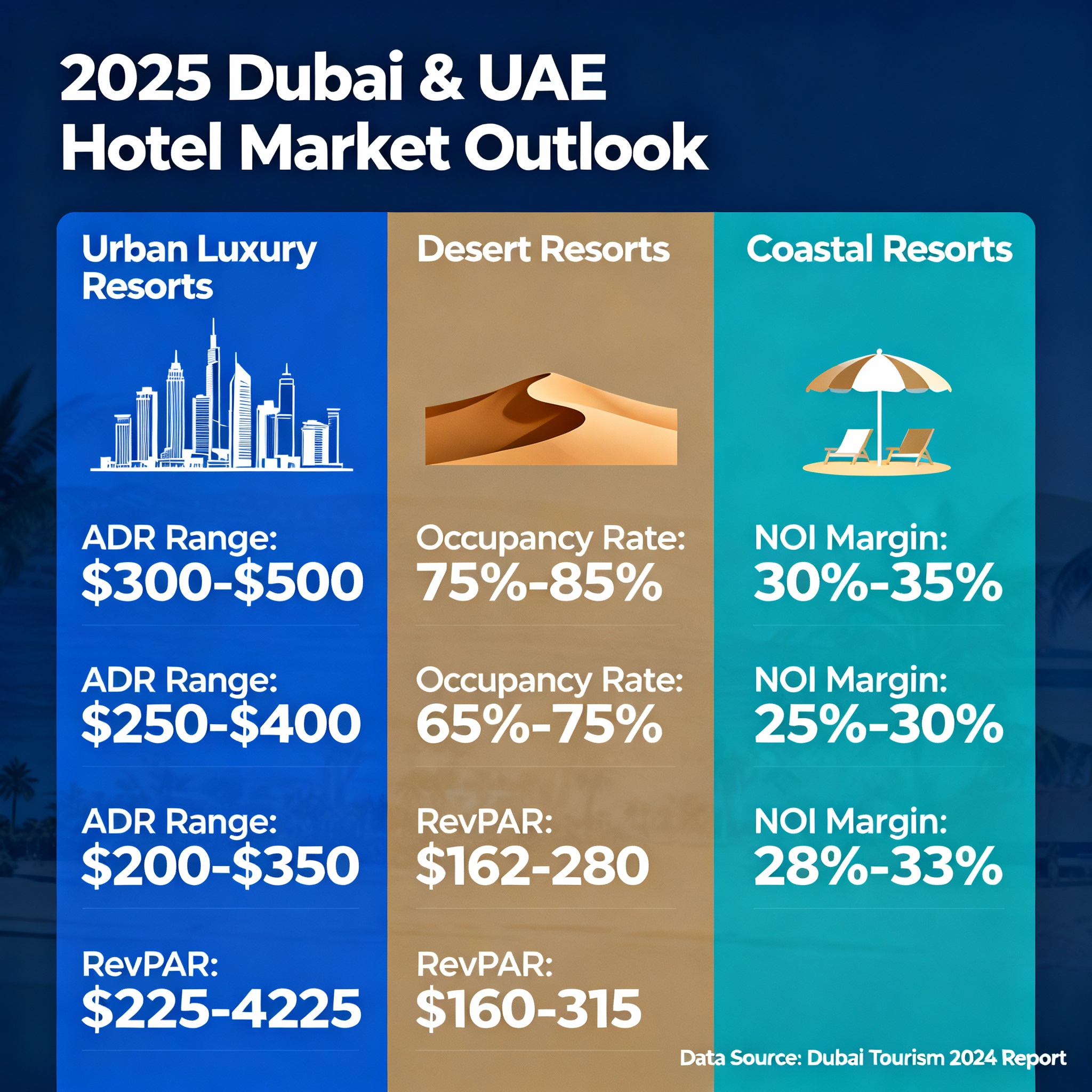
- Dubai urban luxury: ADR €220–€380, occupancy 72–82%, RevPAR €160–€280.
- Abu Dhabi upper-upscale/luxury: ADR €160–€260, occupancy 70–80%, RevPAR €115–€200.
- Desert/coastal resort luxury: ADR €260–€520, occupancy 62–75%, RevPAR €170–€350 (seasonal amplitude higher).
The NOI margin for well-run luxury/upper-upscale UAE assets typically sits a few points above comparable European peers thanks to scale, newer plant & equipment, and brand-led distribution—think low-30s to high-30s % post-fee with strong revenue management and cost discipline.
 Where value is created in 2025 (not just claimed)
1) Brand conversion and tiering
Moving from an independent or weaker flag into a powerhouse brand, or tiering within a brand family (collection → luxury soft brand), can unlock double-digit ADR gains without sacrificing occupancy—provided rooms and key public areas meet standards. The win is not just rate: loyalty capture increases direct mix, improving contribution margins.
What convinces an IC: local comps that show post-conversion ADR/RevPAR, a clean plan for standards compliance, and a three-line explanation of why this flag’s CRM/distribution beats the status quo in this sub-market.
2) Experience-led ancillaries
UAE resorts excel when they monetise time, not just rooms: day-pass and cabana economics, signature dining with reservation yield management, night programming, spa and wellness tiers, and kids/teen academies. These lift TRevPAR and push flow-through because variable costs are well-controlled.
Model properly: add €/occupied room for ancillaries by segment (club, suite, villa) and season. The more granular you are, the more believable your NOI bridge.
3) Suite and mix engineering
Refining key mix (club floors, family suites, villas) shifts ADR upward and reduces rate volatility. In desert/coastal resorts, private pools and view premiums reliably widen rate ladders and lock rate integrity in peak.
4) Cost architecture at scale
Modern plant and equipment (HVAC, hot-water loops), linen cycles, back-of-house design, and centralised purchasing create a structural margin advantage. In 2025, lenders and buyers reward assets that can demonstrate energy and labour discipline with hard numbers, not policies.
Operator selection & contracts: management vs franchise in the UAE
- Management agreements dominate luxury and complex mixed-use properties. You buy brand gravity, global distribution, and systems, at the cost of a higher fee load and reduced owner control.
- Franchise with a capable operator exists in selected urban upper-upscale brackets, offering more NOI control if the owner team has operational depth and is comfortable policing standards.
- Decision framework: Present a one-page “why this contract here”: fee stack, performance tests, capex obligations, key money (if any), and a simple table showing ADR and GOPPAR differentials to local comps under each model.
Development pipeline and its pricing effect
The UAE pipeline is active but curated: brand families expand methodically, destination districts are master-planned, and experiential inventory (beach clubs, desert lodges, themed attractions) is layered to amplify demand rather than commoditise keys. For underwriting, focus on sub-market timing: deliveries that overlap your ramp can soften ADR unless your product and brand clearly lead the ladder.
Practical step: maintain a rolling 24-month opening tracker by district, with brand tier, key count, and positioning notes. Your rate plan should be written against that calendar.
Value-add playbooks by asset type
A) Urban luxury tower (Dubai)
- Thesis: sustain rate leadership and grow direct mix.
- Actions: brand upgrade or tiering; club product refresh; F&B repositioning with yield management; rooftop/pool day-pass economics; suites optimisation.
- Result: ADR +€15–€25, occupancy +1–2 pts; ancillaries +€1.0–1.8k per occupied room per year (by suite tiers).
- Margin: 40–50% flow-through on incremental revenue is achievable with tight cost control.
B) Desert resort (Dubai/Abu Dhabi)
- Thesis: monetise experiences and extend the season.
- Actions: wellness tiers (thermal/holistic), stargazing/astronomy nights, private dinners, dunes and wildlife programming; villa & pool upgrades; HVAC zoning to reduce low-season energy waste.
- Result: ADR resilience in heat months via package value; steady ancillaries; energy savings cushion flow-through.
C) Coastal resort (Ras Al Khaimah/Dubai)
- Thesis: own family and adult premium segments through spatial zoning.
- Actions: family zones vs adults-only areas; cabana inventory, beach clubs, kids academies; signature dining with seating optimisation.
- Result: higher TRevPAR and more predictable shoulder-month revenue; mix built for margin, not just volume.
CapEx scope and payback: what underwrites in 2025
- Rooms soft-hard mix: bathrooms, lighting, beds/linen, climate, smart controls.
- Club & suite product: small, high-impact upgrades where the ADR ladder is most sensitive.
- Public-area “hero” assets: rooftop/pool/club, signature dining, or wellness features with defined pricing tiers.
- Back-of-house: kitchen lines, laundry, storage flows—silent drivers of service quality and labour efficiency.
- Payback thinking: pair each line of CapEx with its €→ADR or €→ancillary effect and a seasonally phased execution plan. Aim for 3–5 years simple payback on refresh scopes; resorts with strong day-use economics may underwrite faster.
Financing & debt sizing
- Expect relationship lending and pricing tied to sponsor quality, brand strength, and cash-flow predictability.
- Underwrite mid-single-digit all-in rates in the base case; show stress at +150–200 bps.
- Size by DSCR first, then sanity-check LTV against market comps.
- For resorts, model working capital troughs in heat months and pre-fund if needed.
IC-friendly language: “The base case services debt across shoulders; the ramp adds coverage headroom by quarter three.”
Risks to price, not ignore
- Heat season volatility: rely on programming and day-use economics rather than rate cuts; show how you defend ADR.
- Brand over-reliance: loyalty engines matter, but local demand building (corporate, events, partnerships) de-risks the P&L.
- Sub-market deliveries: pipeline clusters can test pricing power; ensure your product/flag clearly leads on value and experience.
- Labour and energy: newer assets help, but discipline must be demonstrated, not assumed.
Underwriting checklist
- Market thesis: district, demand drivers, events, airlift, seasonality.
- Comp set: 5–7 hotels with ADR/Occ/RevPAR, brand tier, post-CapEx notes.
- Base P&L normalised; monthly ADR/Occ; TRevPAR and contribution by outlet.
- NOI bridge (24–30 months): brand/contract choice, rooms refresh, one hero public area, package calendar, cost program.
- CapEx phasing with €→KPI tags and simple payback by workstream.
- Debt sizing by DSCR; ramp table; stress case.
- Pipeline tracker (24 months) for your sub-market.
Exit logic: buyer universe (platform/operator/family office) and why they pay your multiple.
The 2025 UAE hotel story is not just “rates are high.” It’s how those rates are earned and defended—through brand selection, experience design, and cost architecture—while programmed ancillaries do the quiet work of margin building. Urban luxury towers, desert destinations, and coastal resorts can each deliver compelling ADR, RevPAR and NOI if your plan is specific to the sub-market and season.
Choose the right flag and contract, design one memorable revenue space, programme the calendar, and show a clear bridge from RevPAR → NOI → value. That is the language investment committees reward in Dubai and across the UAE this year.