

Why this matters (and what “good” looks like)
European hotels can create value fast—but only when underwriting connects market reality to a clear NOI bridge. Good underwriting is not a data dump; it’s a short path from demand & comps → P&L truth → CapEx & contract choices → debt & exit. Below is a practical, investor-grade workflow you can copy.
Step 1 — Define the investment thesis before the spreadsheet
Write one paragraph that fixes the what/where/how:
- Market & micro-location: city/quarter, corporate vs leisure mix, airlift, events, access.
- Asset profile: keys, category (upper-midscale/upscale/luxury), condition, F&B/MICE/wellness, parking.
- Strategy: core+, value-add conversion, or repositioning; buy-to-hold vs fix-and-flip.
- Target outcomes: stabilized ADR, occupancy, NOI margin, hold period, exit buyer universe.
If the thesis can’t be said clearly in 5–6 lines, the underwriting will meander.
Step 2 — Market intelligence & comps that actually matter
2.1 Demand & segmentation
- Leisure vs corporate vs MICE split; weekday/weekend pattern.
- Source markets: domestic, intra-EU, UK, US, GCC; visa/airlift relevance.
- Seasonality: month-by-month. Avoid annual averages that hide winter risk.
- Events calendar: fairs, festivals, sports—price power weeks.
2.2 Supply & pipeline
- Keys within 1–2 km, same class; announced openings (12–24 months).
- New brand entries that re-set ADR ladders.
- Barriers: heritage rules, height limits, licensing caps (short-let, terraces, nightlife).
2.3 Competitive set (Comp Set)
Pick 5–7 directly comparable hotels. For each: ADR, Occ, RevPAR, brand/contract, public-area product, latest CapEx hints. Your model will live or die by whether this comp set is honest.
Step 3 — Crunch the performance math (and show your work)
3.1 Core formulas (keep them visible in your memo)
- RevPAR = ADR × Occupancy
- Rooms revenue per key (RPK) = RevPAR × 365
- TRevPAR = Total revenue ÷ Available rooms
- GOPPAR = Gross Operating Profit ÷ Available rooms
- Flow-through = ΔNOI ÷ ΔRevenue (for the change period)
3.2 Normalise the base year
- Strip one-offs (insurance, COVID rent breaks, subsidies).
- Adjust for owner-specific costs that won’t continue (family payroll etc.).
- Energy and labor at market run-rate (not last year’s anomalies).
- If rooms were out of order, repair ADR/Occ to stabilized availability.
3.3 Stabilised baseline (illustrative)
- ADR €140, Occ 72% → RevPAR €101
- RPK ≈ €36.9k
- Total revenue per key (incl. F&B/SPA) ≈ €48–52k
- NOI margin (post-fee, pre-CapEx) 30–33% depending on labor/energy
Put this on one page with the comp set so readers see the “as-is” truth.
Step 4 — Build the NOI bridge (the page your IC reads first)
Goal: a 24–30-month plan that ties actions to euros.
Actions → KPIs → Money
- Brand/collection conversion (or operator switch):
- Why this flag here.
- Expected ADR delta from distribution/CRM, and direct-mix target.
- Rooms soft CapEx (€8–15k/key typical):
- Bathrooms, lighting, climate, beds/linen.
- Measurable guest-perceived quality → rate integrity.
- Public-area hero piece (pick one):
- Rooftop/bar, event space, or SPA light.
- Attach ancillary €/occupied room target.
- Revenue governance:
- Fences, length-of-stay, package design for shoulders; OTA discipline.
- Cost levers:
- Labor scheduling vs demand curves, energy automation, procurement.
Bridge example (per key, year, conservative):
- ADR +€12; Occ +2 pts → rooms +€2.5–3.5k
- Ancillaries (F&B/SPA/events) +€0.6–1.0k
- Incremental revenue +€3.1–4.5k
- Flow-through 38–45% → NOI +€1.2–2.0k
- At 12× NOI → €14–24k value per key
Do the same math at low/base/high to show resilience.
Step 5 — CapEx that earns its keep (scope, phasing, payback)
5.1 Scope with payback tags
- Rooms: bathrooms, lighting, HVAC, soft goods → ADR lever.
- Public areas: lobby/bar refresh → positioning signal.
- One revenue project: rooftop/event or SPA light → ancillary lever.
- Back-of-house: laundry, kitchen line, IT → cost & quality.
Attach € → KPI tags to each line (e.g., “Rooms soft CapEx €1.8m → ADR +€8–10”).
5.2 Phasing
- Work in shoulder months; target ≤3–5% displacement annually.
- Use mock-ups to test guest response and refine spend.
5.3 Payback math (illustrative)
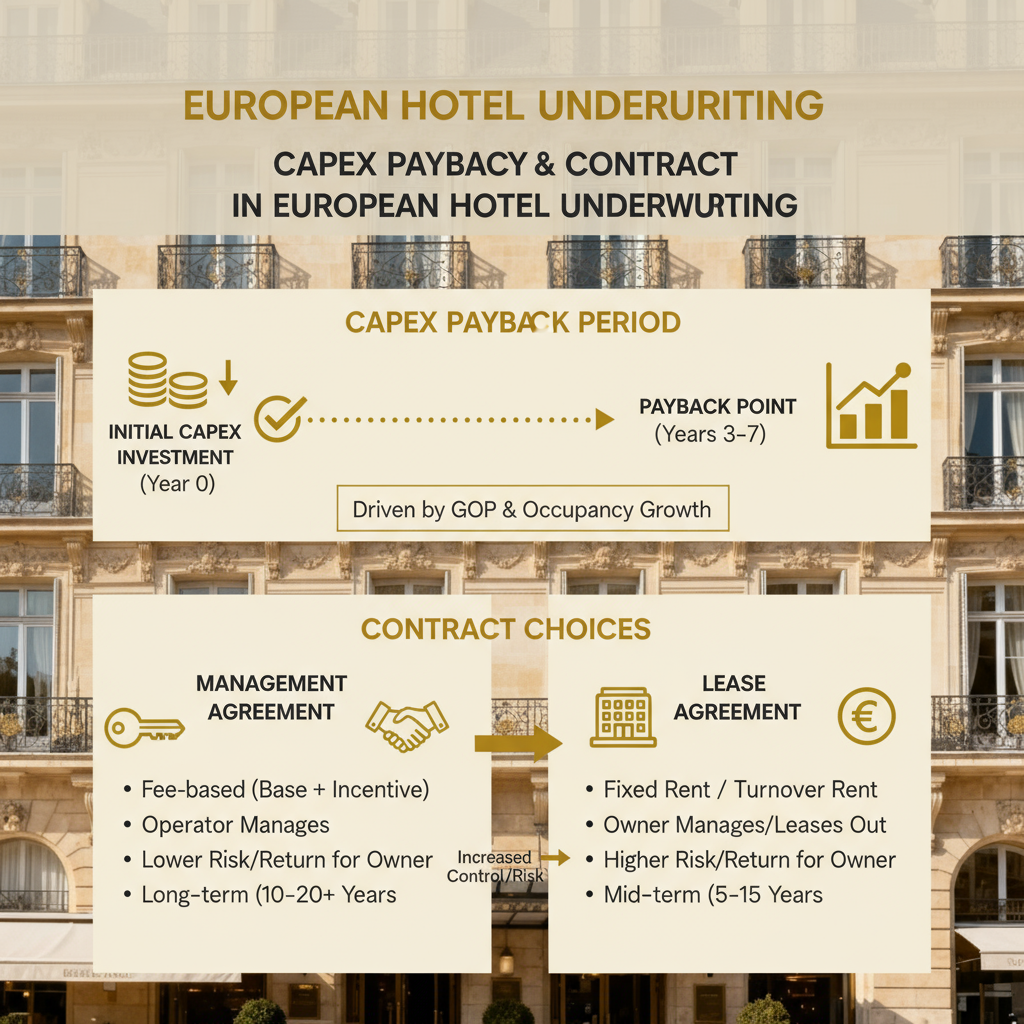
- Rooms soft CapEx €2.0m on 180 keys; incremental NOI €300–360k → 5.5–6.7 yrs simple payback.
- Rooftop/event €0.7m; incremental NOI €150–220k → 3.2–4.7 yrs.
Blend for full project IRR; include contingency 10–15% and inflation.
Step 6 — Contract architecture: management vs franchise (and why)
Management agreement (HMA)
- Pros: brand execution, staffing platform, systems.
- Cons: fee load, owner control lower.
- Works for: luxury/complex assets, owners valuing stability and brand stewardship.
Franchise + third-party operator (TPO)
- Pros: owner control, NOI focus, flexible labor model.
- Cons: more owner oversight, brand standards to police.
- Works for: upper-midscale/upscale city assets with hands-on owners.
Deal the IC likes: “In this micro-market, Franchise+TPO delivers +€9 ADR over HMA comps at similar Occ and −80–120 bps lower fee load; net NOI +€1.2–1.5k/key post-ramp.” Keep it about euros, not philosophy.
Step 7 — Debt sizing: DSCR first, LTV second
7.1 Inputs
- All-in rate: assume mid single digits for institutional borrowers (stress +150–200 bps).
- Amortization: interest-only during works/ramp, then partial amortization.
- Covenants: DSCR, ICR, LTV; equity cure mechanics.
7.2 Size by coverage
- Base NOI → DSCR ≥ 1.5×; Stress case (−5 ADR pts, −2 Occ pts, +10% energy) → DSCR ≥ 1.25×.
- Keep a simple quarterly ramp table to show headroom.
7.3 Working capital
- Seasonality in Europe matters. Model cash troughs; align with facility limits.
Step 8 — Valuation: multiple, cap rate, and per-key sanity checks - NOI multiple (Europe mid-market): 11–13× stabilized NOI; trophy higher, deep value-add lower.
- Cap rate cross-check: NOI ÷ Value; ensure it matches debt and risk.
- Per-key check: price vs comp sales €/key after adjusting for condition, brand, and land.
Exit thinking: who buys it from you? Operator-led platform? Family office? If the answer isn’t obvious, multiples won’t hold.
Step 9 — ESG & efficiency (not a footnote anymore)
- Energy: HVAC automation, heat pumps, LED, water systems → 10–25% utility savings in many European climates.
- Materials & waste: linen cycles, amenity programs; guest-perceived sustainability can support rate.
- Disclosure: lenders increasingly tie pricing to efficiency KPIs; include the roadmap.
Step 10 — Legal & licensing traps to clear early
- Title & encumbrances: ground leases, easements, heritage protections.
- Licenses: rooms, terrace, alcohol, late-night; music/performance.
- Works permits: façade, structural, rooftop; neighbors and HOA dynamics.
- Employment law: union presence, seasonal contracts, works council.
Put counsel notes in an appendix; pre-answer the questions buyers or lenders will ask.
Sensitivity that makes you believable
Run at least three cases:
- Low: ADR +€6, Occ +1 pt, ancillaries +€0.3k/key, flow-through 35% → IRR/X.
- Base: ADR +€12, Occ +2 pts, ancillaries +€0.7k/key, flow-through 40% → IRR/Y.
- High: ADR +€18, Occ +3 pts, ancillaries +€1.0k/key, flow-through 45% → IRR/Z.
Add a cost stress: energy +15%, wages +6%, CapEx +10%. Show the bridge still stands.
Worked example (compact, Europe upscale city, 160 keys)
Baseline (stabilised)
- ADR €145, Occ 74% → RevPAR €107
- RPK €39.1k; total revenue per key €50k
- NOI margin 31% → NOI €2.48m
Plan (18–24 months)
- Rooms soft CapEx €1.6m (€10k/key)
- Lobby/bar refresh €350k; rooftop/event €600k
- Operator conversion (Franchise+TPO)
Effects
- ADR +€12 → €157; Occ +2 pts → 76% → RevPAR €119 (+11.2%)
- Rooms rev per key €43.5k (+€4.4k); ancillaries +€0.8k/key
- Incremental revenue €5.2k/key → €832k total
- Flow-through 42% → NOI +€350k → €2.83m
- Value @ 12× → +€4.2m vs acquisition baseline
CapEx payback (simple): €2.55m / €350k ≈ 7.3 yrs (before multiple effect). With a partial rooftop lease partnership or sponsorship, payback shortens.
Red flags (walk away or re-price)
- Comp set “aspirational,” not comparable.
- Brand uplift promised without micro-market evidence.
- CapEx list without €→KPI tags or phasing.
- Base P&L flattered by one-offs or unrealistic energy/labor.
- Debt case that relies on best-case seasonality every quarter.
- Exit buyer “someone will pay up.” Who exactly?
Underwriting checklist
- Thesis paragraph (market, asset, strategy, outcomes).
- Market: demand split, seasonality, airlift/events, supply & pipeline.
- Comp set (5–7 hotels): ADR/Occ/RevPAR, brand/contract, public areas, recent CapEx.
- Normalized base P&L; core KPIs (RevPAR, RPK, TRevPAR, GOPPAR).
- NOI bridge (actions → KPIs → €): brand/operator, rooms CapEx, one hero public area, revenue governance, cost levers.
- CapEx scope with phasing, payback, contingencies.
- Contract choice rationale (HMA vs Franchise+TPO) with local comps.
- Debt sizing: DSCR/ICR/LTV, ramp table, stress case.
- Valuation: NOI multiple, cap-rate cross-check, €/key sanity.
- ESG/efficiency roadmap with quantified savings.
- Legal/licensing memo; permits & neighbor sensitivities.
- Sensitivities: low/base/high + cost shocks.
- Exit: buyer universe and why they pay your price.
Underwriting a hotel in Europe is about designing NOI you can defend. That means telling a clear story—grounded in comps and seasonality—about how ADR, occupancy and ancillaries change, why this operator/brand delivers it, how CapEx is phased and paid back, how debt behaves in shoulder months, and who eventually buys the result. Do that on one tight memo plus a transparent model, and your deal moves from “interesting” to investable.